PhraseBook for Writing Papers and Research in English
Write, present and publish in English
A PhraseBook to Help You Write, Present and Publish in English
The PhraseBook for Writing Papers and Research contains over 5000 words and phrases to help you write, present and publish in English. The layout of the PhraseBook follows the structure of university and research writing, including Introduction, Method, Presenting Data, Reviewing other Work, Arguing For and Against, Analysis, Presenting Results and Conclusions. Additional sections include Writing Academic Emails and Making a Presentation.
Writing Help sections give advice on university and research writing in English, helping you avoid common errors. Main sections include Style, Spelling, Punctuation and Grammar. An Academic English Thesaurus helps you write with a richer vocabulary.
The PhraseBook is used in over 30 countries in subjects ranging from Medicine, Engineering, Science and Technology to Law, Business and Economics, Political Science, Geography, History, Sociology, Psychology, Language and Education.
It is suitable for university and research writing from undergraduate to graduate student, and from researcher to faculty:
- Over 5000 words and phrases to help you write, present and publish
- Writing help on style, spelling, punctuation and grammar
- Academic English thesaurus to help you write with a richer vocabulary
- Exercises for individual and classroom use
- Global English, including British and American spellings
What readers say about the PhraseBook
«««««
Yes, yes, yes
A time saver for writing journal articles. It may also help when you don’t know what to write next. (Amazon.com)
«««««
Easy to use
Love all the various suggestions on how to compose the same sentence.
(Amazon.com)
«««««
Get this book!
Must have for students.
(Amazon.com)
«««««
Excellent and very helpful
Got this for my partner looking to write a PhD, she loved it. Has been really helpful to her.
(Amazon.co.uk)
«««««
Five Stars
Excellent book for consulting, well laid out, easy to follow and very complete.
(Amazon.co.uk)
«««««
Perfect for academia
This book really helped me write papers and literature reviews. Would recommend for anyone undertaking academic writing. (Amazon.co.uk)
«««««
Very useful book!
I’d been looking for a complete and simple phrasebook for a few days to help me writing my thesis. After a few attempts without being really convinced, I finally came across this book. It fits perfectly my needs and expectations. (Amazon.de)
«««««
Magic book for students
Very useful for my thesis!
(Amazon.de)
«««««
Sehr empfehlenswert
Das Buch ist sehr strukturiert aufgebaut. Man findet sich leicht zurecht und dementsprechend kann man gut damit arbeiten. Ich bin sehr zufrieden. (Amazon.de)
«««««
Good
Useful for research paper writing for all non native speakers of English and enhance the manuscript in all aspects of editing. (Amazon.in)
«««««
Utilissimo
Frasario utilissimo per trovare in breve tempo le migliori espressioni da utilizzare nella preparazione di un articolo o relazione di tipo scientifico. (Amazon.it)
Sections help you structure your text
The layout of the PhraseBook follows the structure of university and research writing, giving you a framework to write in your subject. Below are some example phrases:
Introducing a study, chapter or section
The study will begin by outlining…
This study addresses a number of issues…
The following section sets out…
…to examine the research problem in detail
…to shed light on a number of problem areas in current theory
The paper presented here is based in part on an earlier study
Arguing for and against
This becomes clear when one examines…
This lends weight to the argument that…
Support for this interpretation comes from…
While it may well be valid that…, this study argues the importance of…
A serious drawback of this approach is…
One of the prime failings of this theory or explanation is…
Reviewing other work
X takes little or no account of…
There is little evidence to suggest that…
The study offers only cursory examination of…
X gives a detailed if not always tenable analysis of…
The authors’ claim that…is not well founded.
X’s explanation is not implausible, if not entirely satisfactory.
Analysis and explanation
If, for the sake of argument, we assume…
One of the most obvious consequences of…is…
Although it may well be true that…, it is important not to overlook…
It is important to distinguish carefully between…
The extent to which this reflects…is unclear.
A more plausible explanation for or of…would…
The reason for…is unknown, but…has been suggested by X as a possible factor.
Summary and conclusions
Concluding this section, we can say that…
Chapter X draws together the main findings of the paper.
A number of key issues have been addressed in this study.
This study has highlighted a number of problem areas in existing theory.
While the initial findings are promising, further research is necessary.
The results of this study suggest a number of new avenues for research.
Vocabulary for university and research writing
Colloquial or slang expressions are usually avoided in academic writing: informally you may have a hunch, but in a paper or thesis you put forward a hypothesis. Sensing the distinction between formal and informal English can be difficult; however, all the phrases in the PhraseBook are in the correct style for university and research writing.
Ellipsis dots … mark where to insert your own words
The distinction between … and …
Based on …, we decided to …
X and Y mark where to insert a name
According to X, …
Originally suggested by X, … was subsequently developed further by Y
Alternatives are shown by or and etc.
The results show or demonstrate
The results show, demonstrate, indicate etc.
Optional words or phrases are in lighter text
This shows clearly that …
X claims, in my view wrongly, that …
British and US variants are shown by gb and us
X analyses gb or analyzes us …
a vigorous defence gb or defense us of …
Writing Help on style, spelling, punctuation and grammar
Writing Help sections give advice on Style, Spelling, Punctuation and Grammar, helping you avoid common errors.
Style
Varieties of English — Avoiding colloquial language — Avoiding contracted forms — Avoiding clichés — Avoiding tautology — Referring to yourself — Referring to the reader — Referring generally — he and she — Other types of bias
Spelling
British and US spellings — z and s spellings
Punctuation
Full stop or period — Comma — Semicolon — Colon — Question mark — Exclamation mark or point — Hyphen — Prefixes — The hyphen in fixed compounds — Using the hyphen in temporary compounds before a noun — Dash — The possessive with ’s — Quotation marks — Punctuation at the end of quotations — Punctuating titles, legends and bullets — Parenthesis and ellipsis — References — Abbreviations — Capitalization
Grammar
Noncount nouns — Singular words ending in -s — Irregular plurals — Confusing words: singular and plural — Confusing words: pronouns — Irregular verbs
Academic English thesaurus to expand your vocabulary
A thesaurus is a list of words with similar meanings. The PhraseBook thesaurus is specially compiled for university and research writing, and contains both synonyms (words with a similar meaning) and antonyms (words with the opposite meaning):
Key words for academic writing
It includes key words for academic writing, such as ‘study’, ‘question’, ‘theory’, ‘prove’. These key words have simple umbrella headings, so that by looking up for example ‘prove’, you find alternatives such as substantiate, establish, verify and corroborate.
Antonyms
Antonyms, such as disprove or fail to demonstrate, are given in lighter text
Related words
Cross-references to other key words are marked by ►
The PhraseBook thesaurus helps you helps you write with a richer vocabulary, greater variety, and avoid using the same expressions over and again.
Glossary of university and research terminology
A great deal of English academic vocabulary derives from Latin and Greek; much has also been borrowed from or via French as well as from German, Italian and Arabic, for example, in psychology, music and mathematics. In addition, many of the abbreviations common in university and research writing – such as e.g., i.e. and etc. – and many everyday academic terms – such as campus, school and curriculum – also derive from Latin or Greek.
As modern coinages such as tele + vision and inter + net show, Greek and Latin elements are still used to create new terms today. Knowledge of some Greek and Latin helps you to decipher the meaning of many words, not least for speakers from parts of the world with other classical languages. The PhraseBook includes:
Glossary of university and research terminology
Alma mater, curriculum vitae, extracurricular, magna cum laude, sophomore etc.
Glossary of Greek, Latin and other word elements
Astro, auto, bio, cracy, ecto, infra, nomy, ortho, para, syn, tele etc.
SI and British-American units
Feet, inches and yards, miles, pounds and ounces, gallons and pints etc.
Self-study or classroom teaching
The PhraseBook can be used both for self-study and in the classroom. In the classroom, we recommend that students start with a sample of their own writing, which they use as they work through the PhraseBook.
Students work on their own writing
Rather than working on texts that are irrelevant or uninteresting, students work on their own writing, helping them to improve their real work
Corpus of phrases, thematically grouped
The PhraseBook provides a corpus of phrases, thematically grouped, for use in teaching. Students work through the PhraseBook, expanding their text with phrases from each section. This helps students to think about the different parts of a text and how to structure their argument.
Writing exercises
Each section is followed by writing exercises
After working through the PhraseBook, students will have produced a better written, more polished text.
About the author
Stephen Howe, PhD, is a Professor at the Department of English and Graduate School of Humanities at Fukuoka University in Japan. He was originally a medical student at Newcastle University, but gained his doctorate in Languages and Linguistics at the University of London.
He is an experienced editor of academic English and is cofounder of EnglishforResearch.com, an internet company specializing in academic editing, helping customers write, present and publish in English. Customers included faculty, students and researchers at over 430 universities, organizations and companies in more than 60 countries.
Stephen Howe has been a Visiting Fellow at Wolfson College, Cambridge University, a visiting academic at the University of Cape Town, and a Visiting Fellow at Macquarie University in Sydney. His research has been supported by the British Academy and the Japan Society for the Promotion of Science.
Over 5000 Words and Phrases
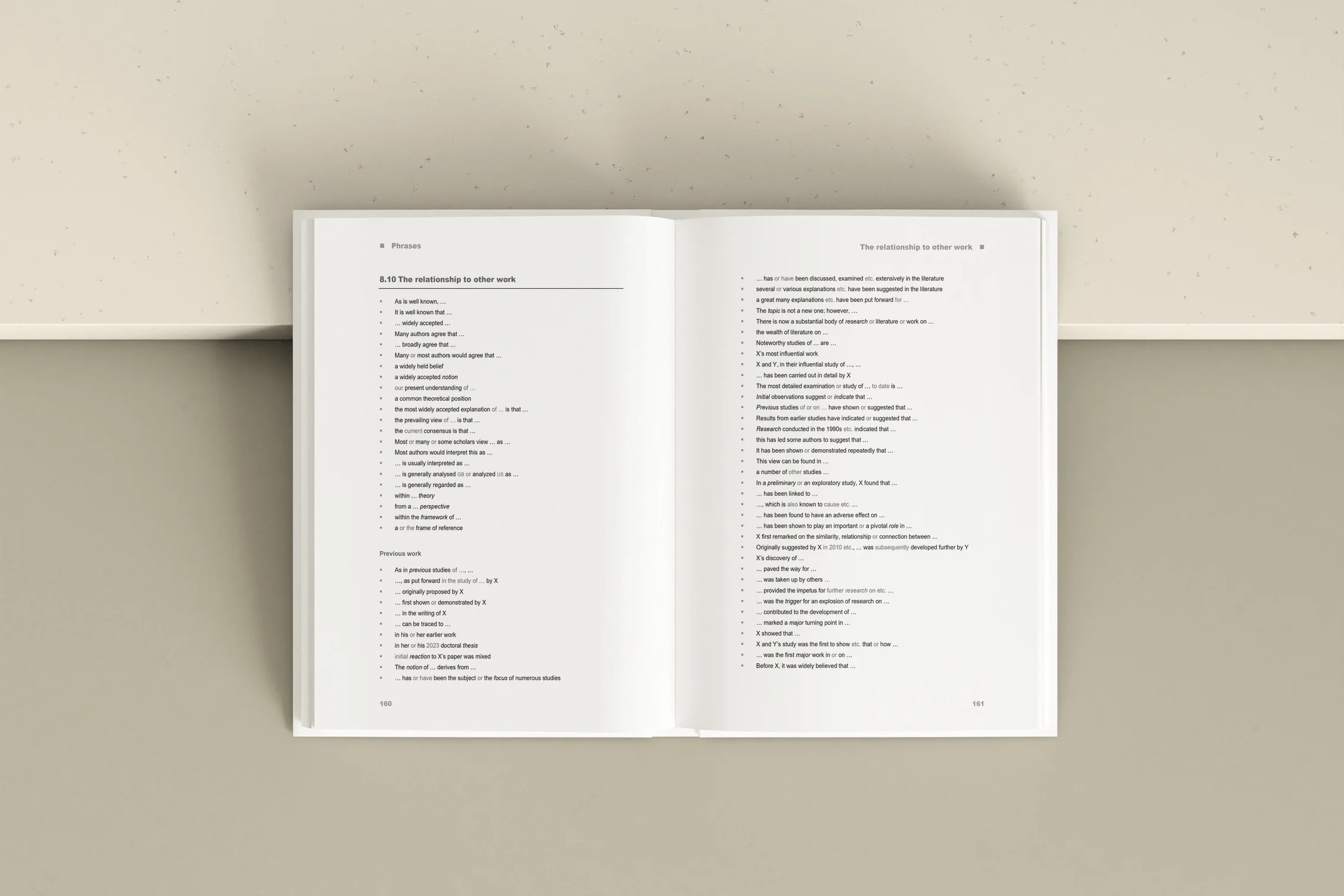
Written by PhD authors, phrases are divided into around 30 main sections that follow the structure of university and research writing, such as Introducing a Study, Defining the Scope of a Study, Arguing For and Against, Reviewing Other Work, Summarizing and Conclusions. Many sections are further divided, for example the Relationship to previous work, Contrasting work and the Limitations of current knowledge. Some example phrases are given below:
Arguing for and against
This point is particularly relevant to…
This becomes clear when one examines…
This lends weight to the argument that…
Support for this interpretation comes from…
To put it another way,…
This raises the question whether…
While it may well be valid that…, this study argues the importance of…
This begs the question why…
A serious drawback of this approach is…
One of the prime failings of this theory or explanation is…
Reviewing other work
X’s study is a textbook example of…
X’s work has had a profound influence on…
The study contains a number of new and important insights: X makes a strong case for…
X takes little or no account of…
There is little evidence to suggest that…
It is very much an oversimplification to…
The study offers only cursory examination of…
X gives a detailed if not always tenable analysis of…
The authors’ claim that…is not well founded.
X’s explanation is not implausible, if not entirely satisfactory.
Analysis and explanation
One tentative proposal might be that…
If, for the sake of argument, we assume…
One of the most obvious consequences of…is…
This would appear to be supported by…
There is some evidence to suggest that…
The importance of…is demonstrated clearly by…
Although it may well be true that…, it is important not to overlook…
It is important to distinguish carefully between…
It is not necessarily the case that…
The extent to which this reflects…is unclear.
A more plausible explanation for or of…would…
The reason for…is unknown, but…has been suggested by X as a possible factor.
Writing Help on Style, Spelling, Punctuation and Grammar
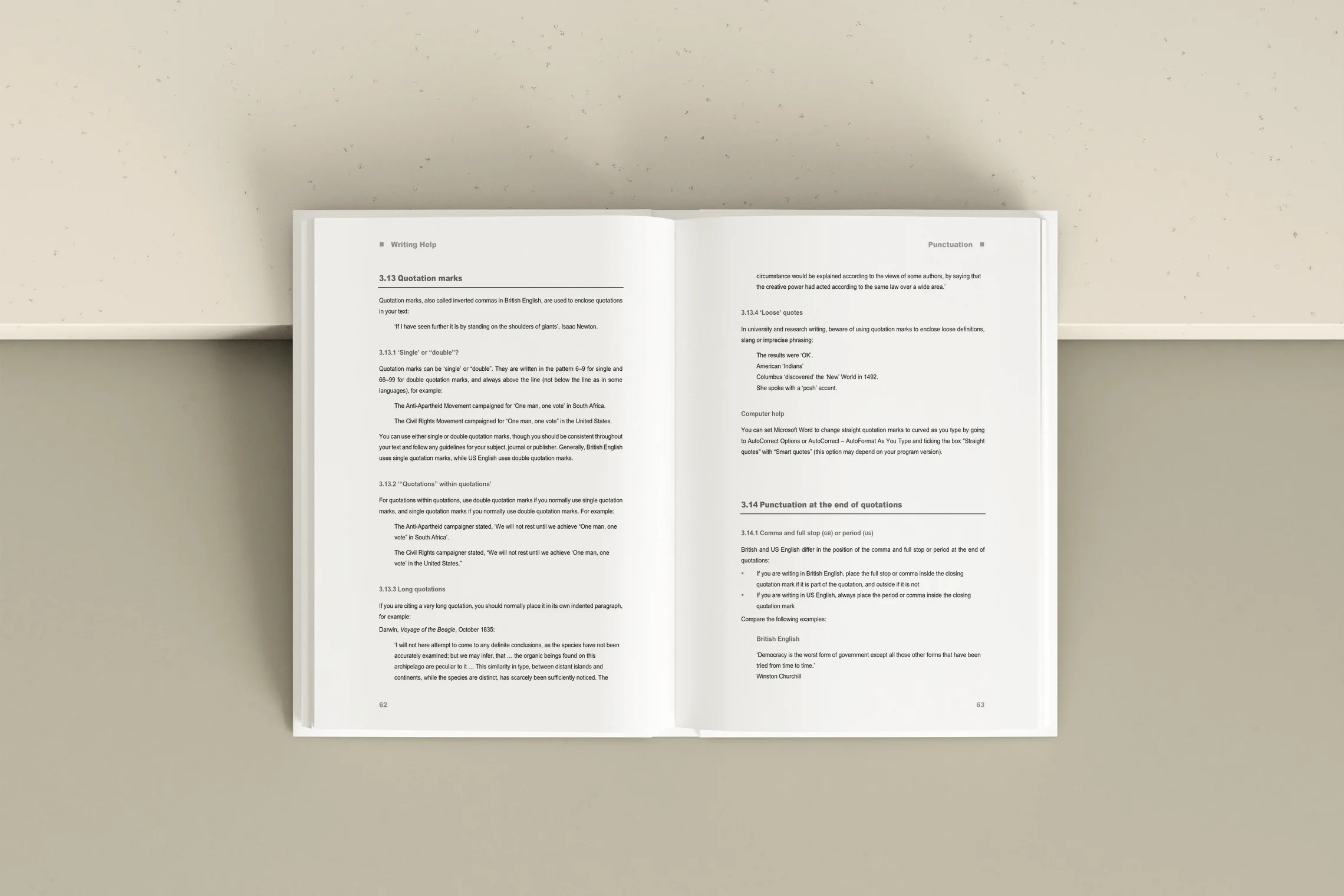
The PhraseBook includes Writing Help sections on Grammar, Style and Punctuation. These sections help you avoid many common errors in English before submitting your text.
University and Research Thesaurus to Build Vocabulary
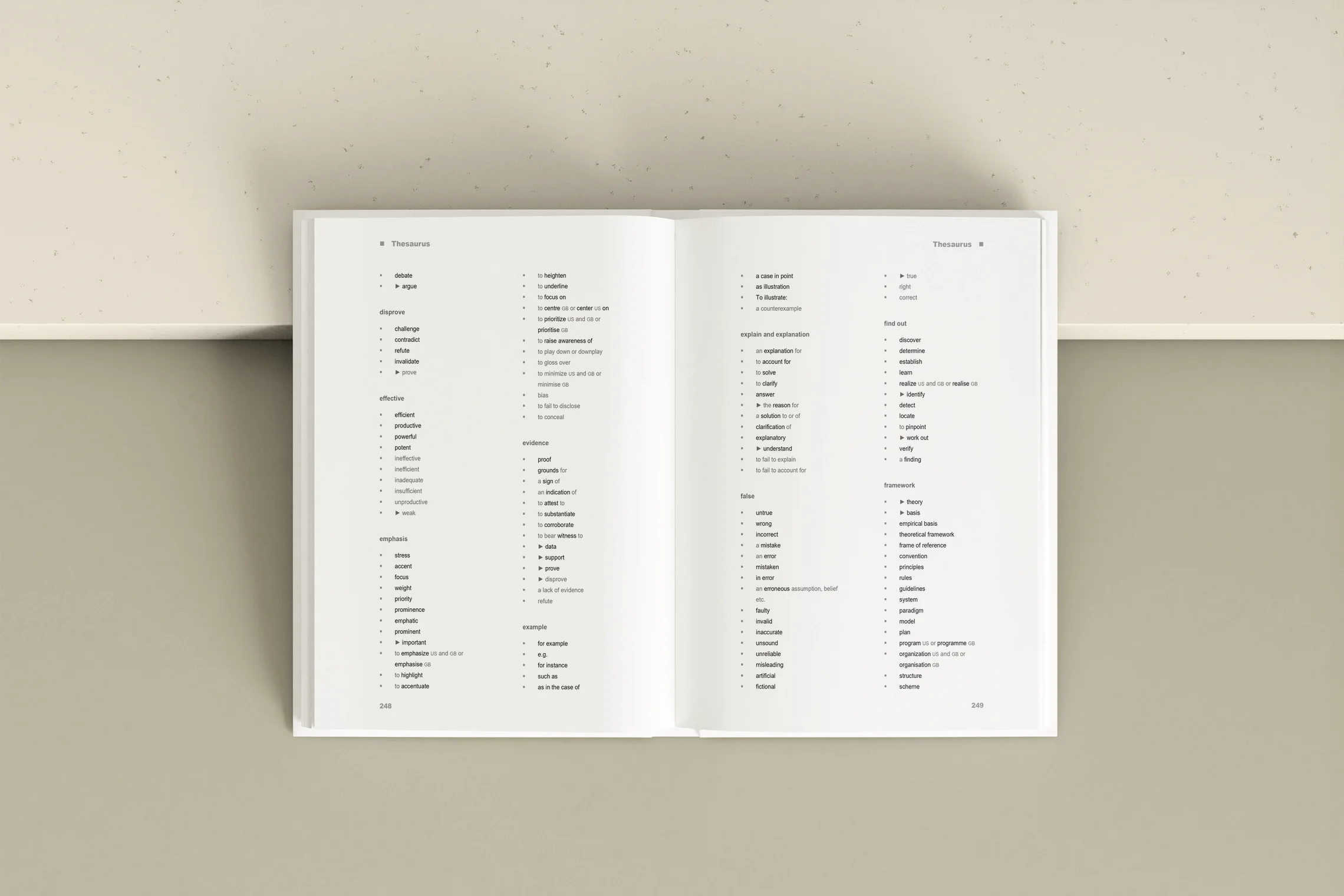
The PhraseBook thesaurus is specifically compiled for university and research writing, and contains both synonyms (words with a similar meaning) and antonyms (words with the opposite meaning). The thesaurus helps you build a richer vocabulary in English and avoid using the same expressions over and again.
Glossary of University and Research Terms
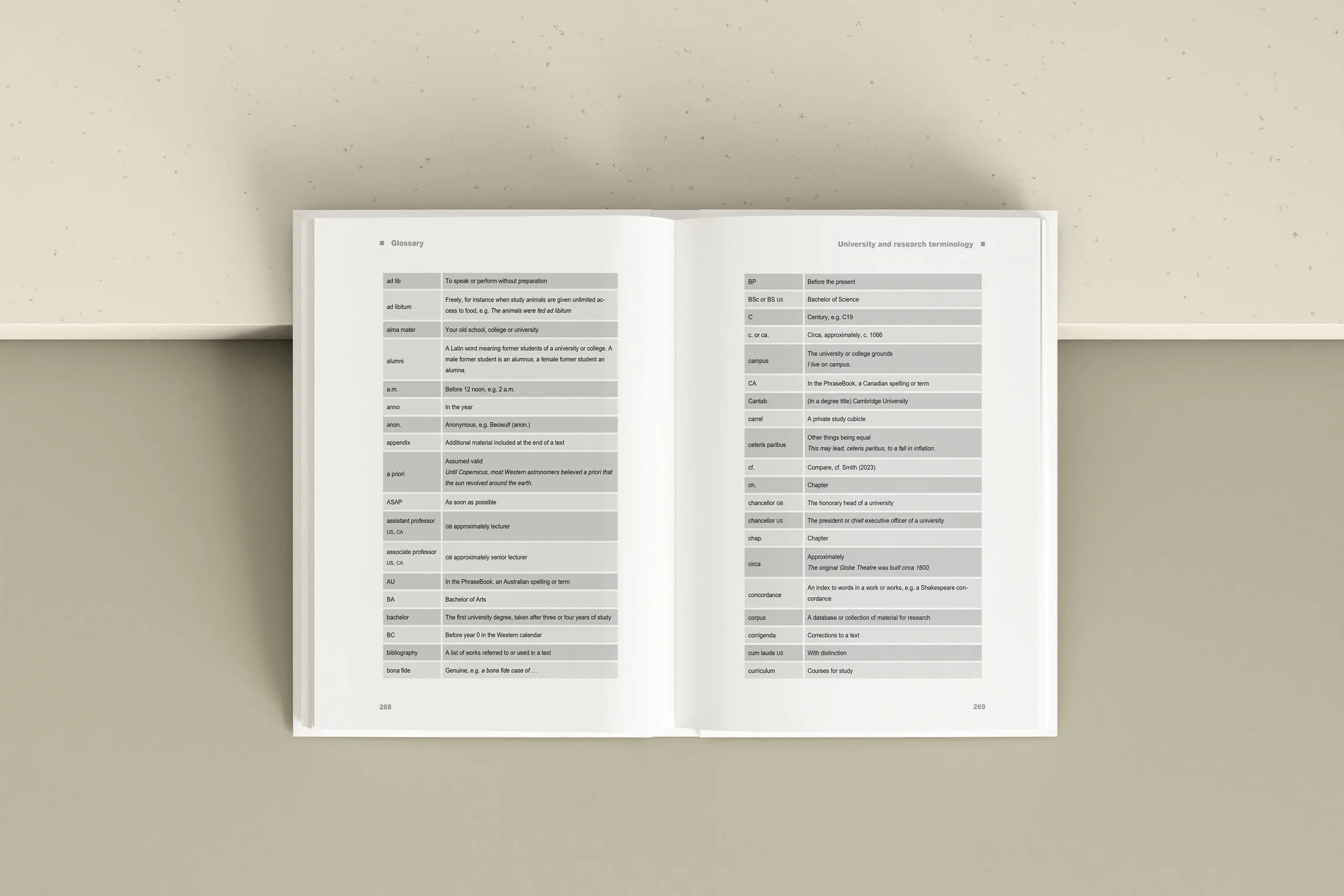
The PhraseBook also includes a glossary with common university and research terminology. A great deal of English academic vocabulary derives from Latin and Greek. Given the large number of foreign elements in English university and research vocabulary, it can be difficult to guess the meaning of an unfamiliar word. Knowledge of some Greek and Latin helps to decipher the meaning of many terms, not least for speakers from parts of the world with other classical languages.
Exercises for Individual and Classroom Use
The PhraseBook is suitable for writing for all English-speaking countries, including the UK, USA, Canada, Australia, New Zealand, Ireland and South Africa. British and American alternatives are given throughout the PhraseBook, and a detailed list of British-US spelling differences is given in the Writing Help section.
Global English
The PhraseBook is suitable for writing for all English-speaking countries, including the UK, USA, Canada, Australia, New Zealand, Ireland and South Africa. British and American alternatives are given throughout the PhraseBook, and a detailed list of British-US spelling differences is given in the Writing Help section.
Buy on Amazon and in bookstores:
- Title: PhraseBook for Writing Papers and Research in English
- Publisher: The Whole World Company Press, EnglishforResearch.com™
- ISBN: 978-1492959793 Paperback
- eBook available on Kindle and other devices